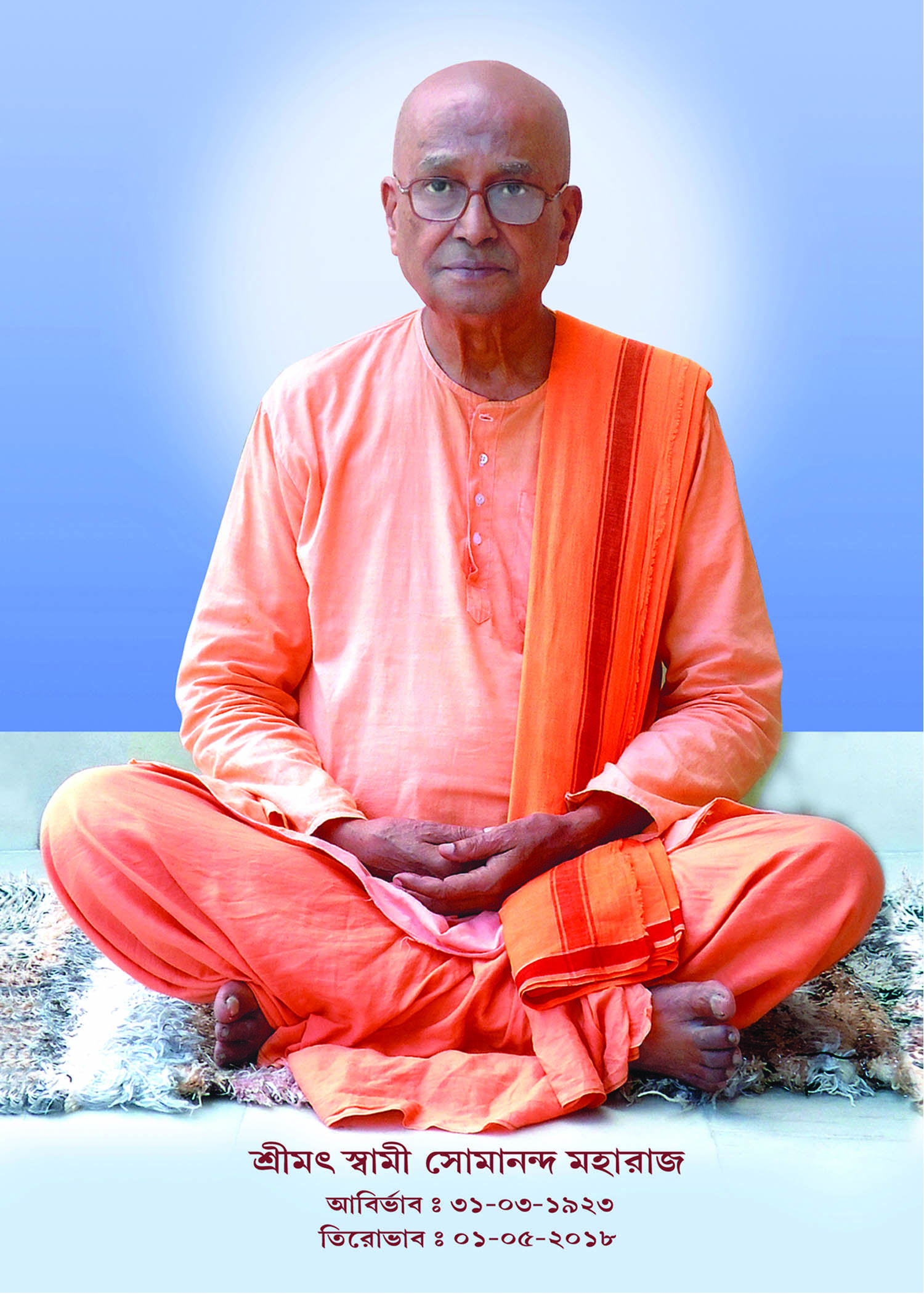
In monastic life, identity is rooted in the guru-disciple tradition. Swami Premghanananda, the founder of Mahesh Shri Ramakrishna Ashram, was a disciple of Swami Shivananda (Mahapurush Maharaj). In this sacred lineage, Swami Somananda emerged as his initiated monastic disciple.
This lineage was not merely formal—it was a living transmission of ideals, discipline, devotion, and selfless service. Guru-bhakti (devotion to the teacher), surrender, and karma-yoga formed the foundation of his life.
Swami Somananda Maharaj was born on 25 March 1923 (11 Chaitra, 1329 Bengali calendar) in Kanihari village, Mymensingh (now in Bangladesh).
His pre-monastic name was Dwijadas Bhattacharya (nicknamed Benu).
His father, Purnachandra Kavyatirtha, was a respected scholar and head pundit, known for his religious discipline and integrity. His mother, Kusum Kumari Devi, was deeply devotional and nurturing.
He grew up in a spiritually enriched environment where daily worship, scriptural traditions, and cultural values shaped his early consciousness.
He was an exceptionally brilliant student:
He consistently ranked first in class and was admired for both academic excellence and moral character.
From a young age, he displayed strong leadership and a spirit of service.
He organized a youth group in his village that engaged in:
The turning point came through the magazine “Kishor Bangla”, which inspired him with ideals of nationalism, character-building, and service.
In 1943, his organization “Kanihari Kishor Sabha” was recognized as the best youth organization—marking his early success as a leader and organizer.
After completing his studies, he began his career as a teacher. Later, he moved to Kolkata and worked:
Despite professional success, he felt a deep inner dissatisfaction, sensing that his life had a higher purpose.
While in Kolkata, he became closely associated with the “Kishor Bangla” publication and gradually took on major responsibilities in its operations.
During this time, he came into close contact with Swami Premghanananda Maharaj. The Swami’s life, ideals, and dedication deeply influenced him.
Eventually, he renounced worldly ambitions and surrendered himself completely at the feet of his Guru.
After initiation, he experienced profound spiritual states, including a deep sense of divinity in all beings—especially perceiving the Divine Mother in all women.
At Mahesh Shri Ramakrishna Ashram, his life’s work unfolded fully.
He played a pivotal role in developing the Ashram into a major center of education and service:
What began as a modest school in 1952 grew into a respected educational hub under his leadership.
He was also an able organizer.
In 1975, he founded the “Sri Ramakrishna Ashram Sangha”, bringing together independent Ramakrishna-inspired ashrams.
He served as its Secretary for over 25 years, guiding and supporting many institutions.
His spiritual life was rooted in:
He emphasized:
“Work itself is worship; service itself is spiritual practice.”
Though he had deep meditative experiences, he always advised balance—warning against excessive austerity without proper guidance.
He had a rare ability to connect with people from all backgrounds. Students, devotees, and common people all felt deeply cared for in his presence.
Even in old age, he remained active and disciplined. Despite health issues, he continued daily spiritual practices and administrative duties.
On 1 May 2018, he passed away, leaving behind a legacy of service, spirituality, and institution-building. His passing deeply affected countless devotees and admirers.
Swami Somananda Maharaj was:
His life demonstrated how selfless service, devotion, and discipline can transform both individual life and society.
Inspired by Swami Vivekananda, he followed the path of Karma Yoga throughout his life.
His message can be summarized as:
“Through selfless service, devotion, and surrender, life attains its highest fulfillment.”

