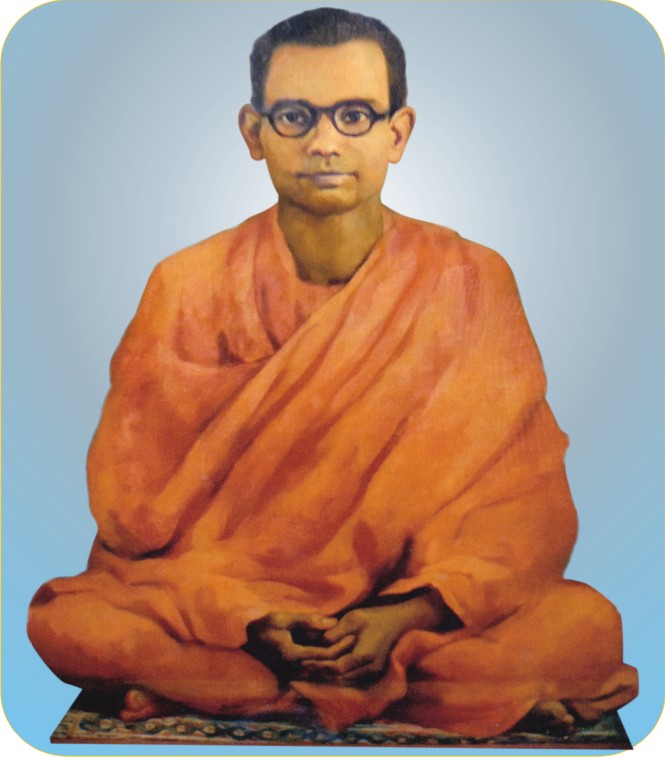
Swami Premghananda was born on August 1902 (2nd Bhadra, 1309 Bengali calendar) in Turinda village, Shariatpur district (present-day Bangladesh).
His father, Ishanchandra Chakraborty, was a learned scholar, and his mother was Sarojini Devi. He grew up in a modest middle-class family. He was the eldest among his siblings, with three brothers and four sisters.
He began his education at a village school and later studied at Panchgaon High School and Birani Bazar High School.
In 1921, during Mahatma Gandhi’s Non-Cooperation Movement, he left formal education. Despite this, he was known as a brilliant and talented student.
He had strong interests in:
Later, he moved to Kolkata and studied art under Abanindranath Tagore, becoming one of his distinguished students.
Swami Premghananda was deeply drawn to spiritual life from a young age.
He received spiritual initiation from Swami Shivananda Maharaj. In 1924, he joined the Sylhet Ashram and dedicated himself to monastic life.
In 1927, he formally took monastic vows and was given the name Swami Premghananda.
He served in several important centers, including:
He played a vital role in:
Swami Premghananda established an ashram-based school in 1932, starting as a primary institution and later developing into a secondary school.
He strongly believed in shaping young minds through discipline, values, and character-building education.
He was a pioneer in youth development and organized activities for young people across Bengal.
Swami Premghananda was a multi-talented personality:
He also had practical skills in:
He suffered from a prolonged illness and underwent treatment in Kolkata, but his condition did not improve.
On April 22, 1956 (10th Baishakh, 1363), at around 7:45 AM, he passed away at the age of 53.
Swami Premghananda dedicated his life to:
His work continues to inspire generations, especially in the fields of character-building, education, and cultural development.
Swami Premghananda ’s life stands as a powerful example of simplicity, dedication, and service. His contributions to society, especially for the youth, remain impactful and relevant even today.